
Maryland Traffic Court Records
Maryland traffic court records are public documents maintained by the Maryland Judiciary across 23 counties and Baltimore City. The District Court handles most traffic matters, from minor moving violations to DUI cases. You can search these records online for free using the Maryland Judiciary Case Search. Records include case status, charges, court dates, and final outcomes. This guide explains where to find Maryland traffic court records, how to request copies, and what each case file typically contains.
Maryland Traffic Court Records Overview
Maryland Traffic Court System
Maryland uses a unified court system to handle all traffic matters. Two levels of trial courts deal with traffic cases. The District Court takes the lead on most traffic work. It handles payable citations for minor violations, DUI and DWI cases, driving on a suspended license, reckless driving, and other criminal traffic charges. District Court judges decide all cases without juries. If you lose at the District Court level, you can appeal to the Circuit Court and get a new trial before a judge or jury.
The Circuit Court handles serious cases. This includes vehicular manslaughter, felony DUI with injury, and civil traffic claims over $30,000. Each of Maryland's 23 counties has its own Circuit Court. Baltimore City runs a separate Circuit Court not tied to any county. The Circuit Court Clerk in each location keeps traffic records for appeals and felony cases filed there. For most people, the District Court is where traffic court records begin and end.
The District Court Traffic Processing Center in Annapolis serves as the central hub for payable citations statewide. You can reach the center at 1-800-492-2656 or 410-260-1093. They handle payments, payment plans, and mail requests for traffic documents. Their mailing address is P.O. Box 6676, Annapolis, MD 21401. Representatives are available Monday through Friday during business hours, and the automated phone system runs 24 hours a day.
Maryland Judiciary Case Search
The Maryland Judiciary Case Search is the main tool for finding traffic court records online. It covers all District and Circuit Court cases filed across the state. You can search by name, case number, or citation number at no cost. The system runs 24 hours a day, seven days a week. Visit casesearch.courts.state.md.us to start a search.
The Maryland Judiciary Case Search portal shown on the main court search page provides fields for name, case number, county, court type, and filing date range. The Case Search system is where most people start when looking up Maryland traffic court records.
The search results display case status, charges, dispositions, and scheduled court dates. Clicking a case number opens the full detail view, including fine amounts and docket entries for that traffic matter.
To use the system, accept the terms and enter a last name. Add a first name or date of birth to narrow the list. You can also filter by county, court type, and date range. Select "Traffic" as the case type and "District Court Only" if that is where the citation was issued. Results come back quickly for most searches. The system works well for checking case status, confirming fine amounts, and verifying dispositions for Maryland traffic court records.
Some records are not included. Red light cameras, school zone speed cameras, and school bus cameras produce citations handled outside the court system. Those do not appear in the Case Search. MVA administrative actions like point suspensions also stay off the court database. For those, contact the Maryland MVA directly at 1-800-950-1682.
Note: Camera-issued citations for red lights and school zone speed enforcement are not part of the Maryland Judiciary Case Search system.
Types of Traffic Court Records in Maryland
Maryland traffic cases fall into two main categories. Payable citations are civil infractions. You can pay the fine without going to court. These cover speeding under the threshold requiring a court appearance, running a red light, failure to yield, improper turns, seat belt violations, expired registration, and other minor offenses. Paying a payable citation still creates a traffic court record in Maryland. The record shows the charge, the fine amount, and the payment status.
The Maryland courts traffic citation self-help page gives a full breakdown of how payable and must-appear citations work, what your options are, and how to respond to each type.
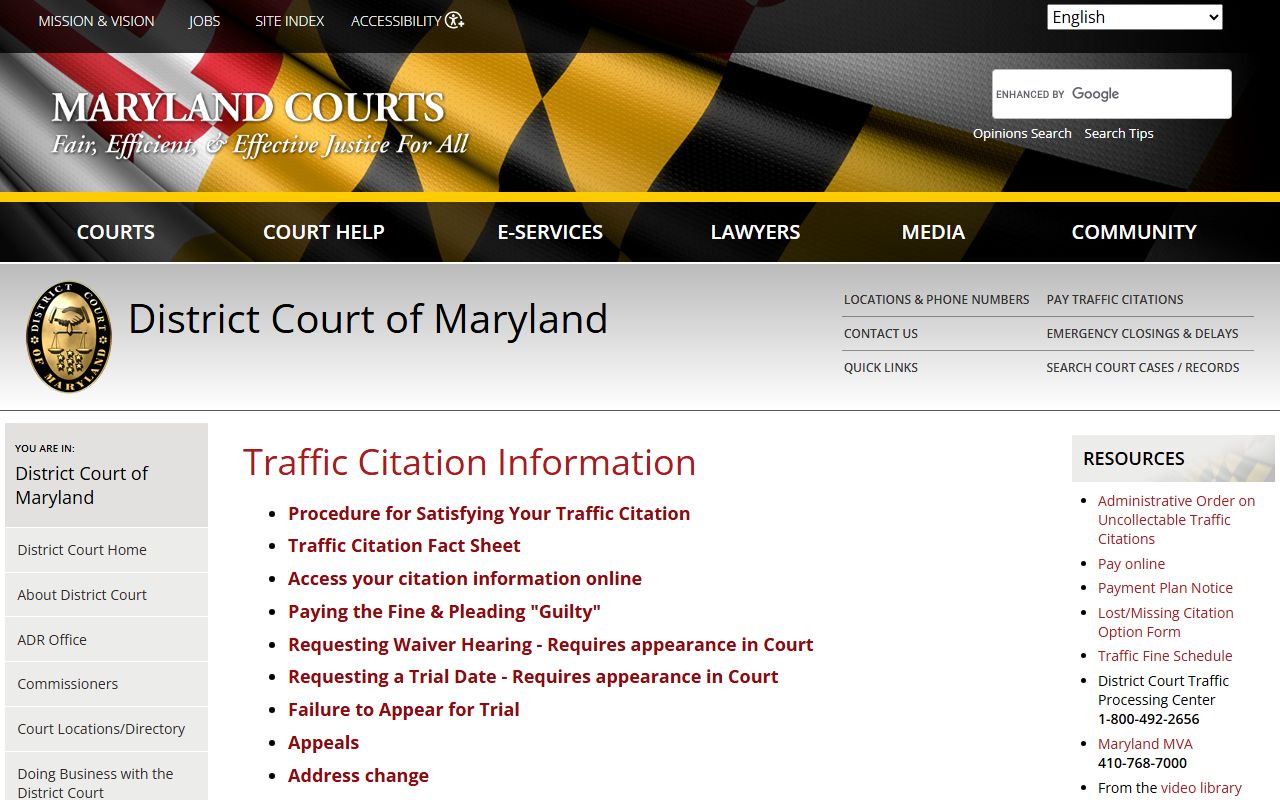
The page walks through each choice step by step, including how to request a waiver hearing through the Maryland Online Resolutions system in counties where that option is available.
Must-appear citations are criminal traffic charges. They require you to show up in court. These include DUI under Transportation Section 21-902, driving on a suspended license under Section 16-303, reckless driving under Section 21-901.1, fleeing from police under Section 21-904, and street racing under Section 21-901.2. All of these create criminal traffic court records visible in the Maryland Judiciary Case Search. A conviction leads to points on your driving record and can trigger a license suspension or revocation. DUI carries 12 points alone, which brings automatic revocation.
A third category is automated enforcement. Red light cameras, school zone speed cameras, and school bus cameras generate these violations. They go through the issuing jurisdiction, not the court system. No points are assessed. They do not appear on your driving record or in the Case Search database. Ocean City in Worcester County handles a high volume of tourist-related officer-issued citations during summer months, and those do appear in the regular court record system.
How to Request Maryland Traffic Court Records
The Maryland Judiciary website is the starting point for most records requests. It links to the Case Search, court locations, forms, and self-help resources for traffic matters across all 24 jurisdictions.
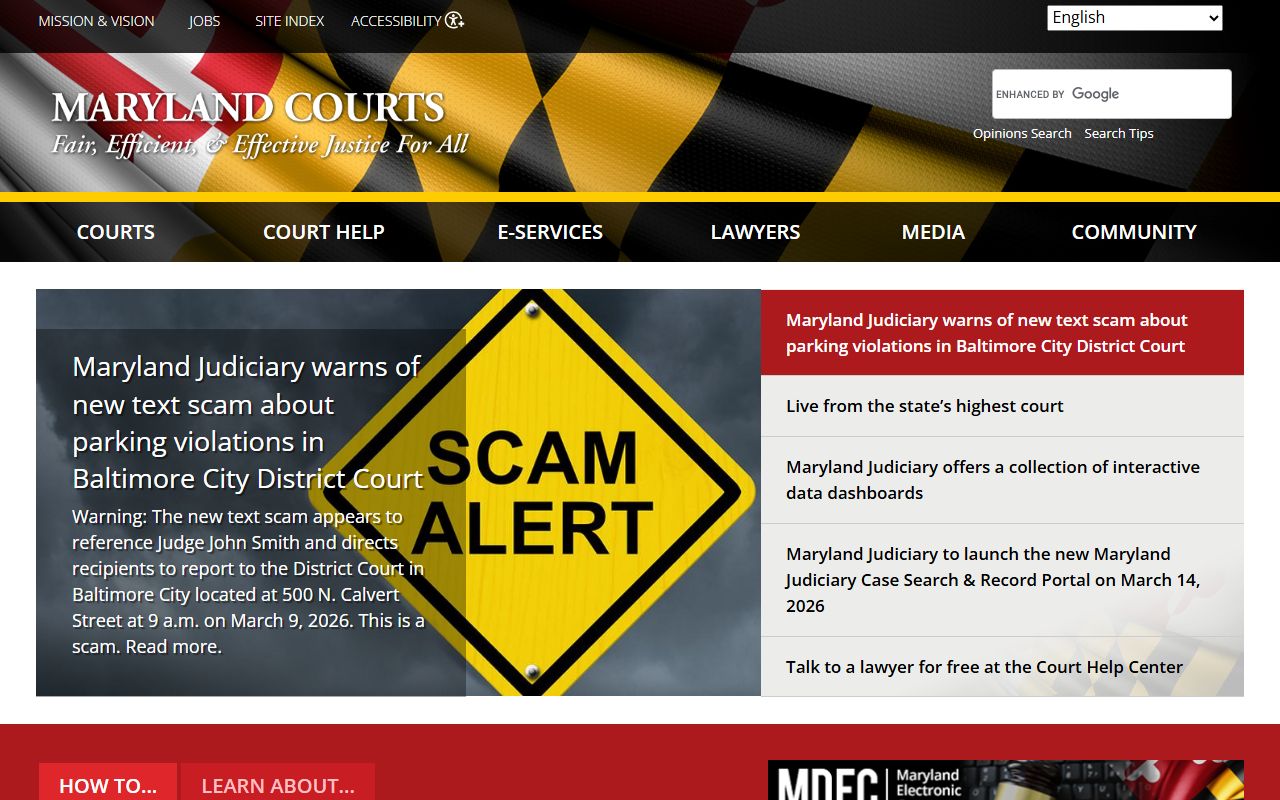
The site also lists all District Court locations by county with direct contact information, which is useful when you need to call or visit a specific clerk's office about a traffic case.
There are four ways to get Maryland traffic court records. Online through the Case Search is free and instant for most case data. Phone through the IVR system at 1-800-492-2656 gives you case status and fine amounts any time. In-person at the District Court in the county where the case was filed lets you view the full file and get copies the same day. By mail to the District Court Traffic Processing Center (P.O. Box 6676, Annapolis, MD 21401) works well for certified copies and older cases. All methods give you access to the same underlying records.
Copy fees are standard across the state. Plain copies cost $0.50 per page. Certified copies cost $5.00 per document. Audio recordings of court proceedings cost $15 by CD or $10 in electronic format. Court transcripts run $3.00 per page. Pay in person by cash, check, or money order made out to "Clerk of the District Court." Not all locations accept credit cards, so call ahead to confirm. For mail requests, include the full name, date of birth, date of violation, citation number if available, and the county where the citation was issued.
Maryland Online Resolutions (MDOR) is available in select counties including Montgomery, Allegany, Garrett, Howard, and Talbot. MDOR lets you plead guilty with explanation, request a payment plan for fines of $150 or more, or plead not guilty and request a trial, all online. Visit mdor.courts.state.md.us if your county is listed. Payment plans require 10 monthly payments of 10 percent each under Courts and Judicial Proceedings Section 7-504. Use form DCA-131 to request a plan through the District Court Traffic Processing Center.
- Online: Maryland Judiciary Case Search at casesearch.courts.state.md.us
- Phone: 1-800-492-2656 (IVR system, available 24 hours)
- In-person: District Court in the county where the case was filed
- Mail: District Court Traffic Processing Center, P.O. Box 6676, Annapolis, MD 21401
Maryland MVA Driving Records
The Maryland Motor Vehicle Administration handles driver records separately from court records. Court records track what happened in a case. MVA records track your license status, point totals, and insurance compliance. Both matter when reviewing a full traffic history in Maryland. A court disposition and an MVA point entry are different things, though they are related.
The Maryland MVA website offers driver license status checks, point balance lookups, and online payment for MVA-issued fines and fees.
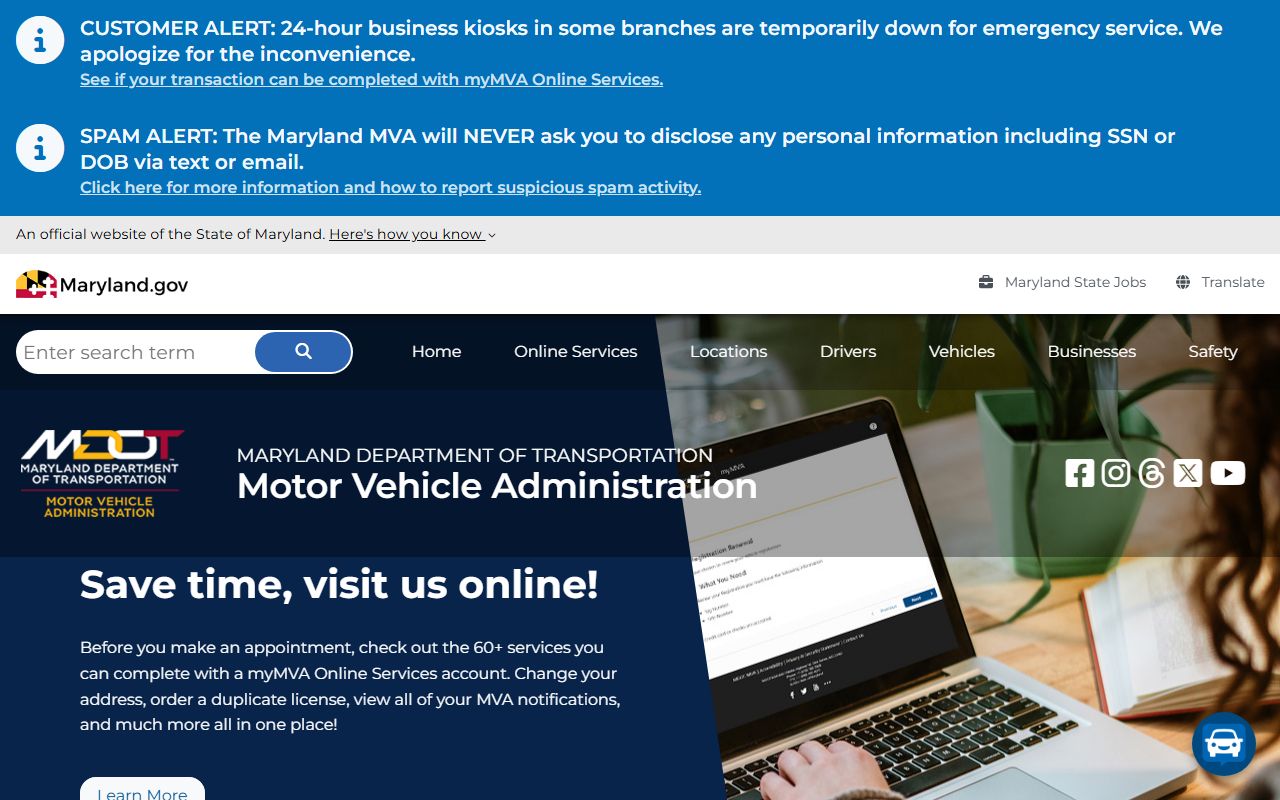
You can reach the MVA at 1-800-950-1682 for questions about your driving record or license status, and the website also has a kiosk locator for in-person payment of traffic citations.
Maryland uses a point system tied to traffic convictions. Speeding 1 to 9 mph over the limit earns 1 point. Speeding 10 to 19 mph over brings 2 points. Reckless driving adds 6 points. A DUI conviction tacks on 12 points, which triggers automatic license revocation. The MVA sends a warning letter at 3 or 4 points. You must attend a Point System Conference at 5 to 7 points. Your license faces suspension at 8 to 11 points and revocation at 12 or more. Points drop off 2 years after conviction if you stay clean. You can check your current point balance on the MVA website at any time.
Expungement works differently at the MVA than in court. For MVA records, non-destructive violations clear automatically after 3 years. Alcohol and drug-related violations stay on the MVA record for 10 years. Court records follow a different schedule under the Public Information Act and the courts' own retention rules.
Maryland Traffic Laws and Traffic Court Records
Maryland traffic law draws from the Transportation Code, the Courts and Judicial Proceedings Code, and the General Provisions Code. These statutes define violations, set out how courts handle cases, establish what records are kept, and determine who can access them. When you look at a traffic court record in Maryland, you will see statute numbers listed next to each charge.
The Maryland Code Search tool lets you look up any statute by title and section number, which is helpful when you want to understand what a charge on a traffic court record actually means.
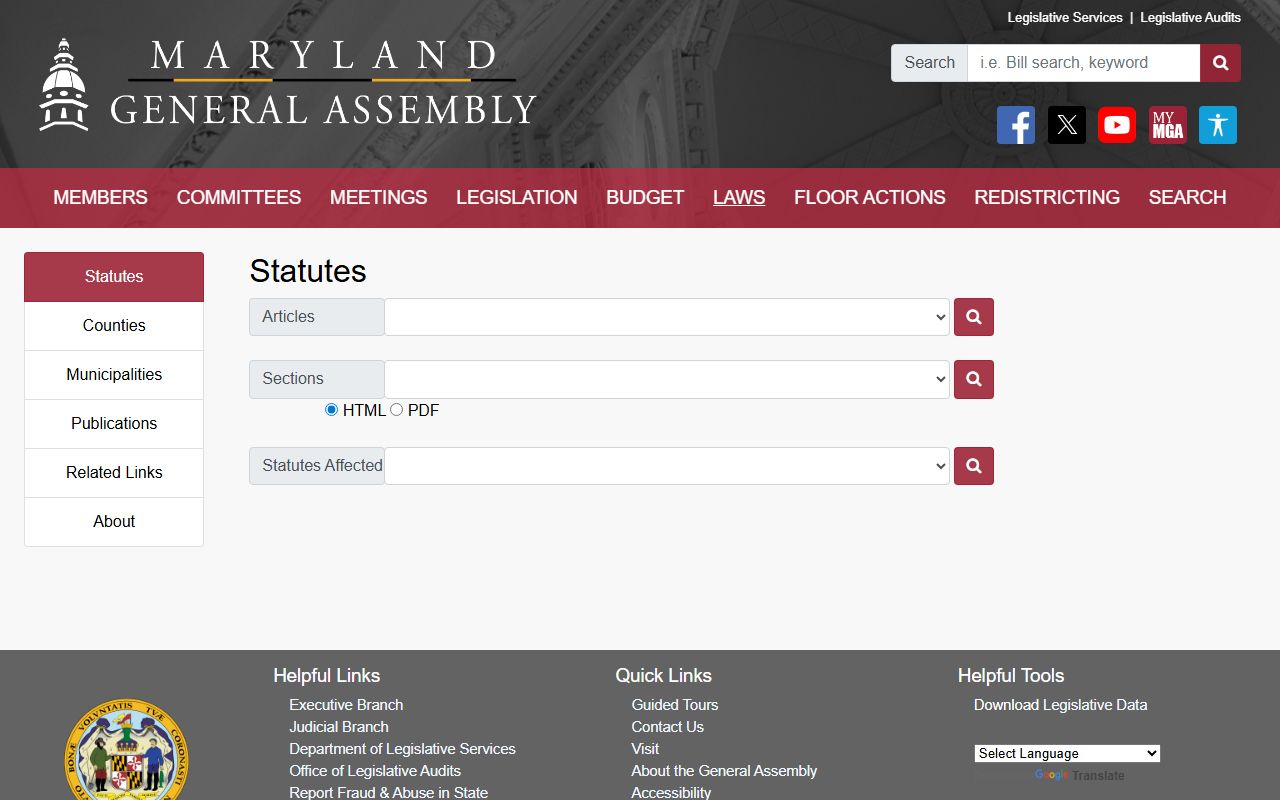
The code search covers the full Maryland Annotated Code, including the Transportation Article where most traffic offenses are defined, and the Courts and Judicial Proceedings Article that governs how records are maintained and accessed.
Common statutes on Maryland traffic court records include: Transportation Section 21-902 for DUI and DWI, Section 21-801 for general speed restrictions, Section 21-201 for traffic signal violations, Section 16-303 for driving on a suspended license, and Section 22-201 for insurance violations. Each appears on a citation by section number. The disposition next to that charge shows whether the person was found guilty, not guilty, had the case dismissed, or received probation before judgment.
Public access to court records is guaranteed under General Provisions Section 4-101 and Section 4-201. These are Maryland's Public Information Act provisions. Most traffic court records are open to anyone without needing to give a reason. Courts must respond to records requests within 30 days. Some data, such as juvenile traffic records or sealed cases, may be withheld, but standard adult traffic records are accessible throughout Maryland. Certain personal identifiers like full birth dates and home addresses may be partially redacted from public copies under Section 4-333.
Historical Maryland Traffic Court Records
Online access to Maryland traffic court records depends on when the case was filed. Montgomery County has the oldest digital records, going back to 1979. Prince George's County cases start from 1982. Baltimore County records are online from 1984. Anne Arundel County cases start in 1989. Carroll County records date to 1990. Charles County goes back to 1998. Allegany, Garrett, Harford, Howard, and Washington counties start from 1999. Most remaining counties have digital records from 2000 onward. For cases filed before those cutoff years, you need to contact the local court directly.
For older cases not available through the Case Search, the Maryland State Archives stores historical court records transferred from county courts over time.
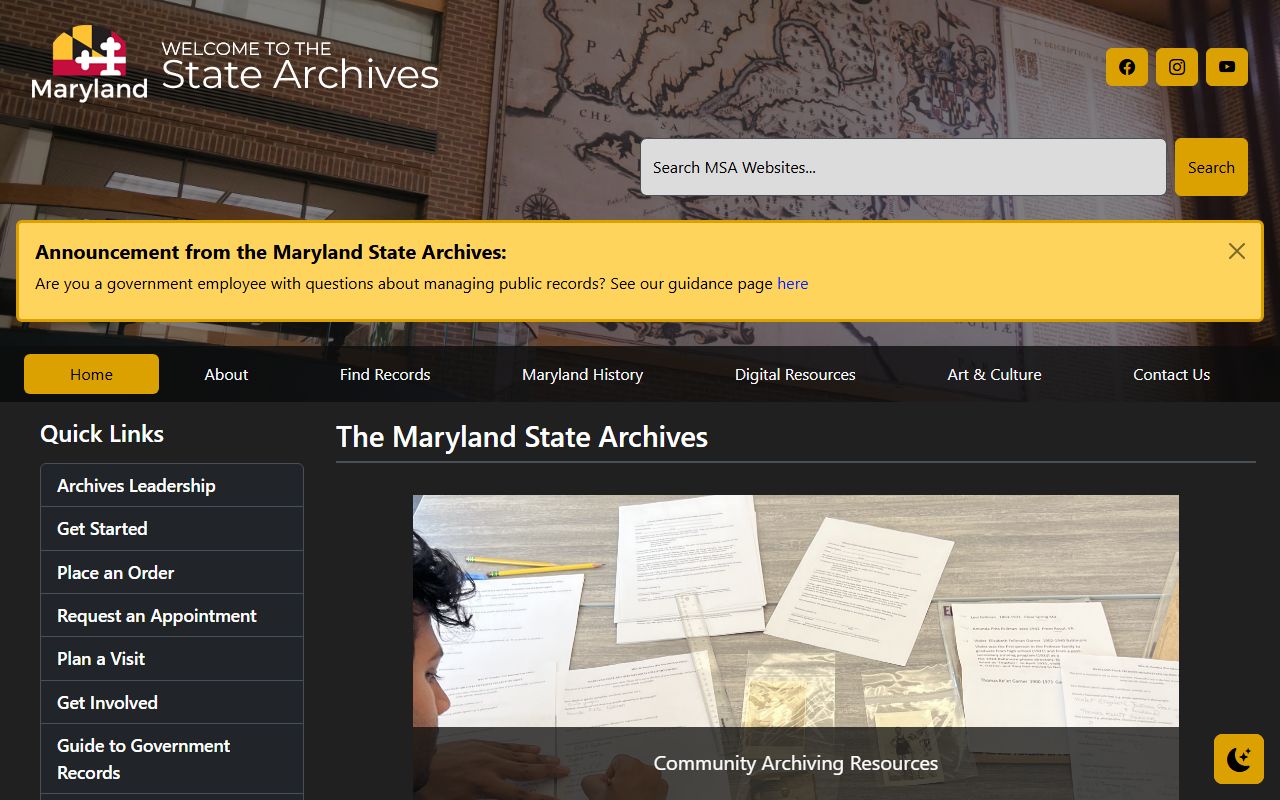
The State Archives is at 350 Rowe Boulevard in Annapolis. You can reach them at 410-260-6400. Some records require an in-person visit or a written request with advance notice.
For cases before the online cutoff date, contact the District Court in the county where the case was filed. Clerks can search physical indexes for older records. Bring as much information as you have: the person's full name, approximate year, and the county. The clerk will tell you if the record still exists and what it costs to get a copy. Under the court's retention schedule, District Court traffic citations are kept for 3 years after disposition. DUI and DWI cases are retained for 10 years. Circuit Court felony records are kept permanently. Records past the retention period may no longer be available.
The Maryland District Court forms page lists all standard request forms, including DC-034 for inspecting public records in person and DC-046 for requesting archived records stored at the Maryland State Archives. These forms are free to download and submit.
Browse Maryland Traffic Court Records by County
Each of Maryland's 23 counties and Baltimore City has its own District Court. Pick a county below to find court contact info, local procedures, and records access options for that area.
Traffic Court Records in Major Maryland Cities
Residents of Maryland's largest cities file traffic cases at their county or city District Court. Pick a city below to find local courthouse details, search tools, and traffic records resources.